🇮🇳 INDIAN ECONOMY ANALYSIS
Period: April – December 2025
Source: Quant-based macro analytics by 1POINT6 Research
1. EXECUTIVE SUMMARY
India’s macroeconomic indicators currently present a picture of strong growth resilience, improving labour conditions, and a policy-supported expansion cycle, despite pockets of external imbalance. The economy continues to outperform most global peers, supported by robust domestic demand, easing financial conditions, and structural reforms.
While certain stress points such as the widening current account deficit and firming inflation warrant monitoring, the overall macro setup remains constructively bullish for long-term growth and investment activity.
2. Key Economic Metrics — Current Snapshot
| Metric | Current | Previous | Interpretation |
|---|
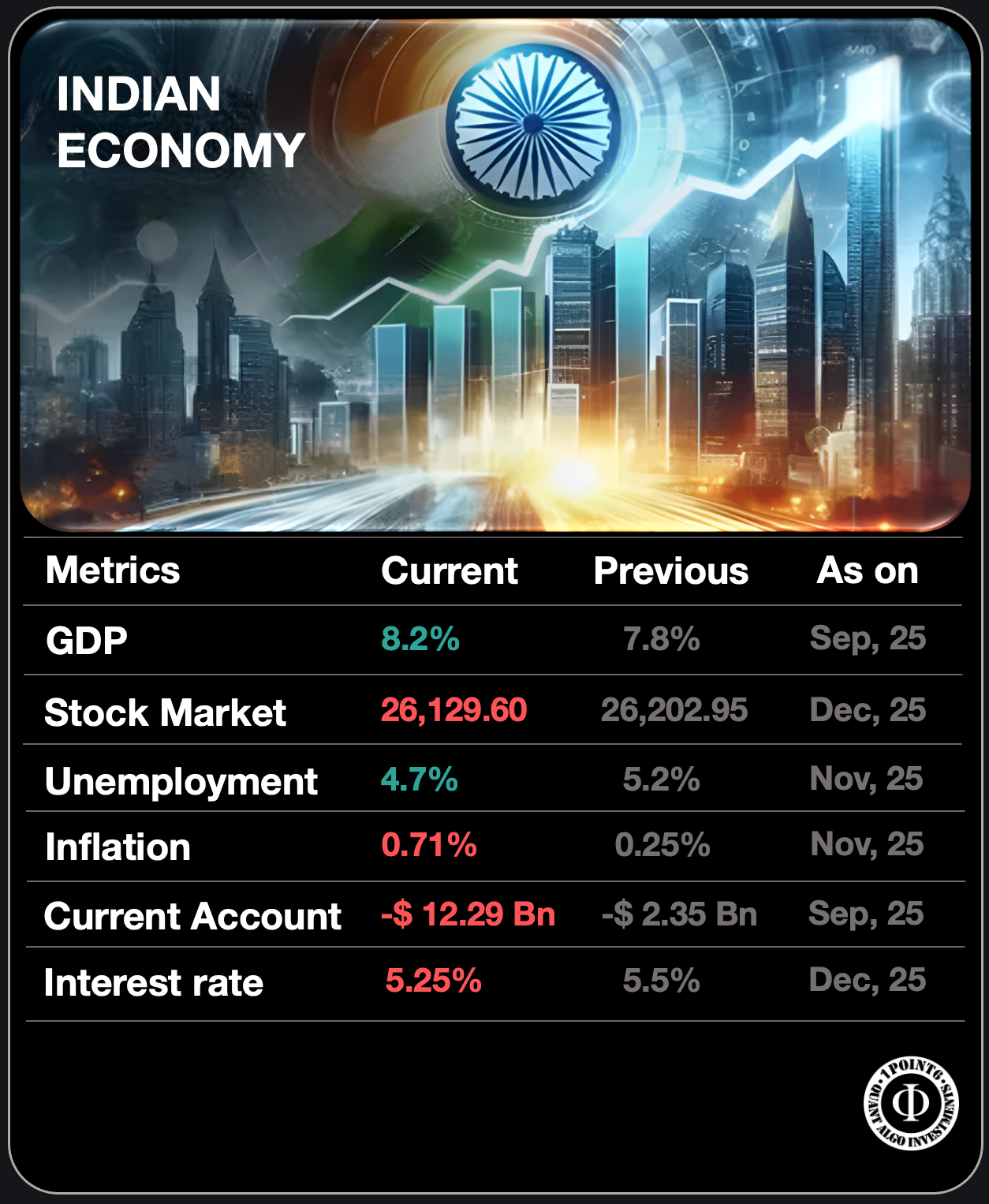
| GDP Growth | 8.2% | 7.8% | Strong acceleration, broad-based expansion |
| Equity Market (NIFTY 50) | 26,129.60 | 26,202.95 | Consolidation near highs |
| Unemployment | 4.7% | 5.2% | Improving labour participation |
| Inflation | 0.71% | 0.25% | Normalising but contained |
| Current Account | –$12.29 Bn | –$2.35 Bn | External imbalance widening |
| Policy Interest Rate | 5.25% | 5.5% | Easing monetary stance |
3. Growth Dynamics: GDP & Real Economy
3.1 GDP Growth at 8.2% — Structural Strength
India’s GDP growth at 8.2% underscores:
Strong domestic consumption
Capital expenditure-led expansion
Services sector resilience
Manufacturing recovery driven by infrastructure and policy incentives
This growth rate reflects structural momentum rather than cyclical rebound, indicating sustainability beyond short-term stimulus.
Key takeaway: India remains firmly positioned as a high-growth large economy, with growth drivers deeply rooted in domestic demand.
4. Labour Market & Consumption
4.1 Declining Unemployment — Demand Multiplier
Unemployment falling to 4.7% signals:
Improved job creation across services and manufacturing
Rising disposable incomes
Strengthening consumption cycle
Lower unemployment feeds directly into:
This reinforces a self-sustaining domestic growth loop.
5. Inflation & Monetary Policy
5.1 Inflation at 0.71% — Controlled Environment
Although inflation has risen from previous lows, it remains:
Well within manageable levels
Non-disruptive to consumption
Supportive of policy flexibility
5.2 Interest Rate at 5.25% — Growth Supportive
The reduction in policy rates indicates:
Confidence in inflation containment
Shift toward growth support
Lower borrowing costs for businesses and consumers
Policy implication: Monetary conditions are now favourable for credit growth, capex, and equity valuations.
6. External Sector: Current Account Dynamics
6.1 Widening Deficit — A Watch Point
The current account deficit expanding to –$12.29 Bn reflects:
Higher imports due to growth-led demand
Energy and capital goods inflows
Investment-driven expansion rather than consumption excess
While this requires monitoring, it is not currently destabilising, especially given:
7. Equity Markets & Financial Conditions
Despite strong macro data, equity markets are:
This behaviour aligns with:
Markets appear to be pricing growth durability rather than short-term exuberance.
8. Key Drivers of the Indian Economy
Structural Drivers
Infrastructure-led public investment
Manufacturing incentives and localisation
Digital and financial inclusion
Urbanisation and demographic dividend
Cyclical Drivers
Policy Drivers
Fiscal discipline with growth orientation
Monetary easing with inflation vigilance
Reform continuity and execution focus
9. Forward Outlook: 12–24 Month Perspective
Base Case (High Probability)
GDP growth remains above 7.5%
Inflation stays contained
Gradual improvement in external balances
Equity markets remain trend-positive with rotations
Upside Scenario
Risk Factors
At present, risks are manageable and not trend-altering.
10. Conclusion
India’s current economic metrics point to a balanced, growth-oriented macro environment. The economy is:
Growing fast
Creating jobs
Managing inflation
Supporting investment
While external imbalances warrant vigilance, they are a by-product of expansion, not stress.
The medium- to long-term outlook for the Indian economy remains structurally strong, policy-supported, and investment-friendly.